 GAIK
GAIKOverview
Guides and automates GenAI solution development
The guidance layer provides process guidance and supporting tools that help organizations navigate the journey from identifying a GenAI opportunity to deploying a working solution. Rather than requiring teams to figure out everything from scratch, this layer offers structured pathways, decision support, and automation to make the development process more efficient and less error-prone.
GenAI Solution Implementation Process
At the core of the guidance layer is a GenAI solution implementation process and guide that walks teams through the key steps: from strategic planning and requirements capture, through design and development, to deployment and evaluation.
This process integrates activities across all other layers of the toolkit, ensuring that technical implementation is grounded in business needs, supported by clear requirements, and aligned with security and compliance expectations.
GenAI implementation activities are structured along two lenses: 1. Solution lens (or use case lens), 2. Organization lens
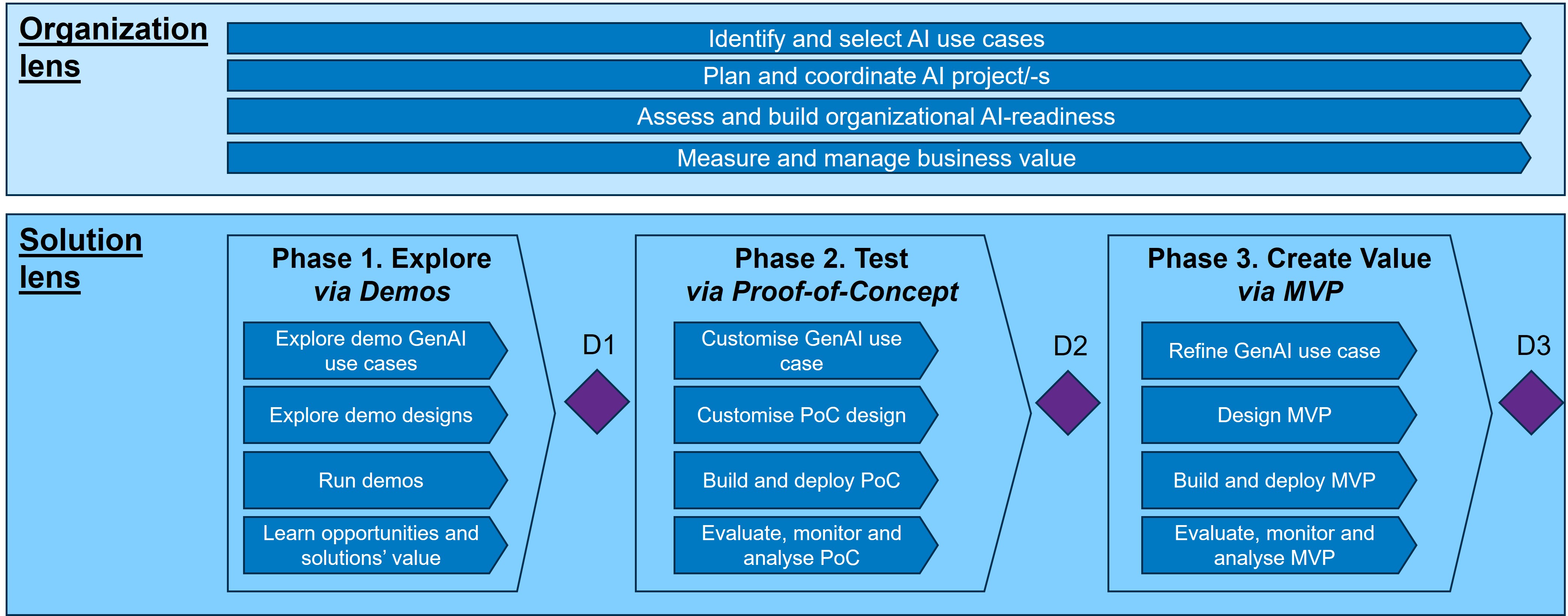 Fig. 1 The end-to-end GenAI solution implementation process, including phases, key activities, and decision points.
Overview
From the solution (use case) lens the process consists of three phases that guide an organization from initial exploration to value creation with GenAI. It starts from the organization’s strategic goals and concrete problems or challenges, and progresses through demos, a proof-of-concept (PoC), and finally a Minimum Viable Product (MVP). Progress between phases is governed by decision points (shown as purple diamonds in Fig. 1), ensuring that further investment is made only when sufficient value and feasibility are demonstrated.
Phase 1 – Explore via Demos
Purpose: Rapid learning and shared understanding.
Key activities:
- Explore demo GenAI use cases
- Explore demo designs
- Run demos
- Learn about opportunities and potential solution value
Outcome: A shared understanding of what GenAI can do, which use cases are relevant, and whether there is enough potential value to proceed.
Decision Point D1: At the first decision point, stakeholders decide whether to:
- Proceed to a Proof-of-Concept (PoC)
- Refine the problem or use case
- Stop the initiative
Phase 2 – Test via Proof-of-Concept (PoC)
Purpose: Validate feasibility and value in a realistic organizational context.
Key activities
- Customize the GenAI use case
- Customize the PoC design
- Build and deploy the PoC
- Evaluate, monitor, and analyze PoC results
Outcome Evidence regarding:
- Technical feasibility
- Quality and reliability of outputs
- Business relevance and early value
Decision Point D2 At the second decision point, stakeholders decide whether to:
- Proceed to an MVP
- Rework or extend the PoC
- Stop the initiative due to limited value or high risk
Phase 3 – Create Value via Minimum Viable Product (MVP)
Purpose: Transform validated ideas into tangible business value.
Key activities
- Refine the GenAI use case based on PoC learnings
- Design the MVP and the surrounding work system (processes, roles, governance)
- Build and implement the MVP
- Evaluate, monitor, and analyze MVP performance
Outcome A working GenAI solution embedded in real operations and delivering measurable value.
Decision Point D3 At the final decision point, stakeholders decide whether to:
- Scale the solution further
- Integrate it into core systems and operations
- Iterate on the MVP or discontinue the solution
Summary
This process is:
- Iterative and decision-driven, rather than purely linear
- Designed to progressively reduce uncertainty
- Structured to ensure that investment increases only when learning, feasibility, and value are demonstrated
The decision points act as safeguards, helping organizations move from experimentation to sustainable value creation with GenAI.
Organization Lens: GenAI Implementation at Scale
In addition to developing individual GenAI solutions, organizations must address GenAI implementation from an organization-wide lens. This lens focuses on alignment, coordination, and value creation across multiple initiatives.
Identify and Select AI Use Cases: Organizations identify and prioritize GenAI use cases in line with strategic goals and business priorities, forming a coherent portfolio of initiatives.
Plan and Coordinate AI Projects: GenAI initiatives are planned and coordinated across teams to ensure alignment, efficient use of resources, and consistency across projects.
Assess and Build Organizational AI Readiness: Organizations assess and strengthen their readiness for GenAI adoption, covering technology, data, skills, governance, and ways of working.
Measure and Manage Business Value: Business value from GenAI is measured and managed at an organizational level to guide investment decisions and ensure alignment with strategic objectives.
Relationship Between Solution Lens and Organization Lens
- The solution lens focuses on developing and validating individual GenAI solutions.
- The organization lens ensures coherence, scalability, and value across all GenAI initiatives.
Together, both lenses enable structured and sustainable GenAI adoption.
How to Start with the Toolkit
The GAIK toolkit serves different user needs depending on your role and objectives. Choose your starting point:
Starting from the Technical Side
For developers and technical teams implementing GenAI solutions:
- Explore the Implementation Layer - Review available software components and modules
- Try the Toolkit Demo - Test individual components and complete pipelines interactively
- Review Use Cases - See technical implementation examples for real-world scenarios
- Check usage examples - Visit software component examples and software module examples for code samples
- Install the Python package - Get started with code-based implementation using
pip install gaik - Check the GitHub repository - Access source code, examples, and technical documentation
Recommended path: Demo → Software Components → Usage Examples → Implementation
Starting from the Strategic Side
For decision-makers evaluating GenAI adoption and use case selection:
- Review the Strategy Layer - Understand use case selection frameworks and value evaluation approaches
- Explore Use Cases - See how GenAI addresses real business challenges across different sectors
- Assess organizational readiness - Contact our team for AI implementation capability assessment tool (AICapDev)
- Evaluate expected value - Apply the value evaluation framework to potential use cases
- Review the Roadmap - Understand the project's development phases and planned capabilities
Recommended path: Strategy Layer → Use Cases → Value Evaluation → Use Case Selection
Starting from the Business Side
For business analysts and process owners designing GenAI solutions:
- Explore the Business Layer - Learn how to define use cases and design workflows
- Review Use Cases - See complete business context, workflows, and expected outcomes
- Try No-Code Assets - Deploy solutions using prompt templates and agent skills without coding
- Define your use case - Use the GenAI Product Canvas to structure your solution
- Test with the Demo - Validate concepts with real toolkit capabilities
Recommended path: Business Layer → Use Cases → No-Code Assets → Demo
Starting with Testing & Exploration
For anyone wanting to try the toolkit hands-on:
- Visit the Live Demo - Access is available upon registration request
- Test software modules - Try Audio-to-Structured-Data, Document-to-Structured-Data, and RAG-Workflow
- Experiment with components - Test individual capabilities like Transcriber, Extractor, Parser, and Classifier
- Try real-world demos - Test incident reporting and construction diary use cases
- Explore Use Cases - See detailed documentation for what you tested
Recommended path: Demo → Software Modules → Use Cases → Implementation Layer
GAIK's Roadmap
The GAIK project follows a phased development approach throughout 2026, progressing from initial toolkit development to real-world application:
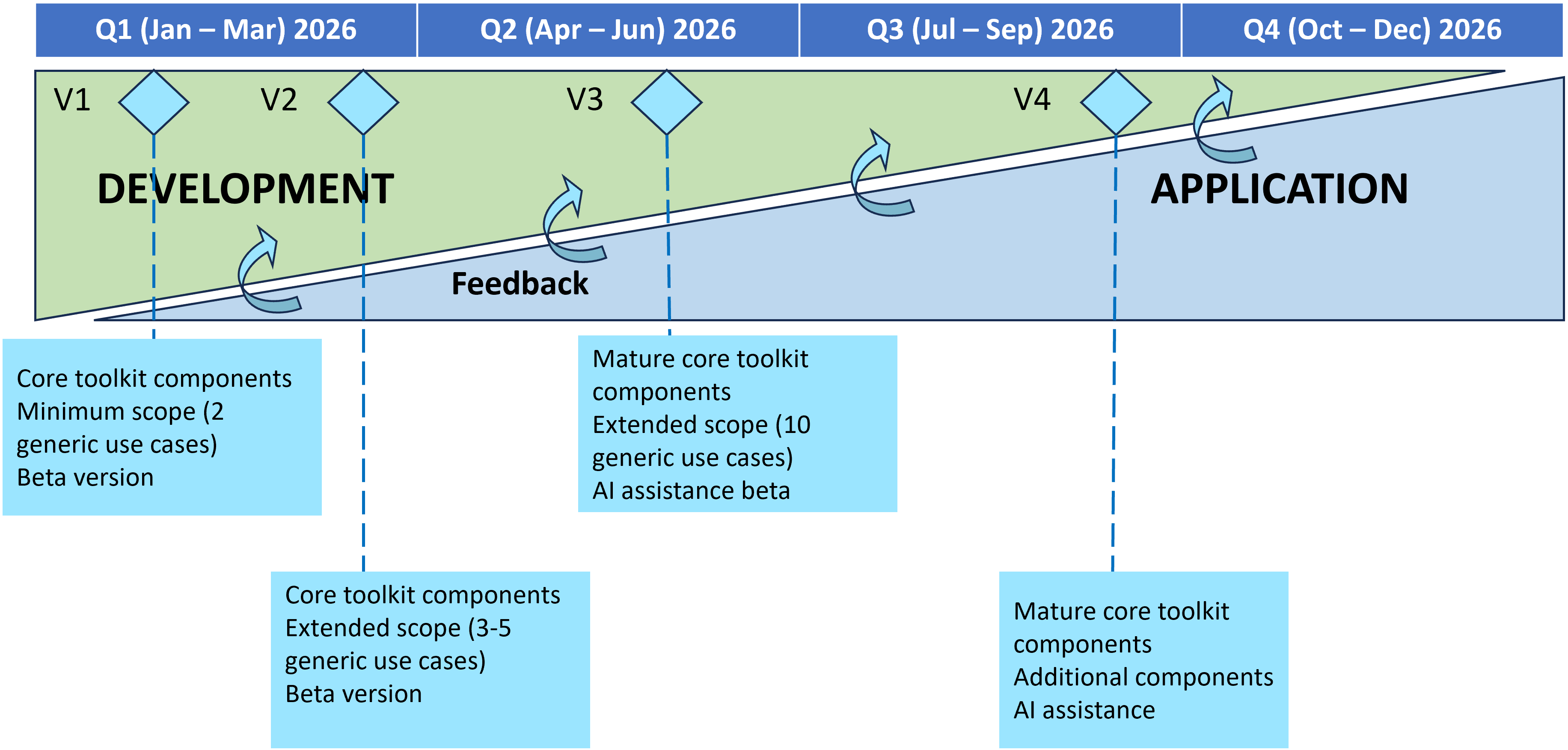
The project evolves through four major versions (V1-V4), transitioning from Development phase (Q1-Q3) to Application phase (Q4). Core toolkit components are established in early versions with a minimum scope of 2 generic use cases, expanding to 10 generic use cases by V3. The final quarter focuses on mature toolkit deployment, additional components, and AI-powered development assistance. Continuous feedback loops throughout the year ensure the toolkit remains aligned with real-world needs.
GAIK Consortium
The GAIK project is implemented by a consortium of four companies and five academic partners with expertise in business digitalization, knowledge management, data science, generative AI, and natural language processing.
Project Partners
Academic Partners:
- Haaga-Helia University of Applied Sciences (coordinator)
- University of Helsinki
- Tampere University of Applied Sciences
Industry Partners:
- Luvata - Manufacturing sector
- Lotus Demolition - Construction sector
- QAdental - Healthcare and well-being sector
- Azets - Business digitalization and consulting
The consortium combines cutting-edge research with real-world business needs from manufacturing, healthcare and well-being, and construction sectors. The toolkit targets identified use cases tailored to contemporary business requirements, as reflected by the needs analysis of the partner companies.
The project continues to extend cooperation with additional companies and international partners.
GAIK Support for Companies
Beyond providing the open-source toolkit, the GAIK team offers direct support to help companies successfully adopt and customize GenAI solutions for their specific use cases. We provide two tailored support tracks depending on where you need the most help:
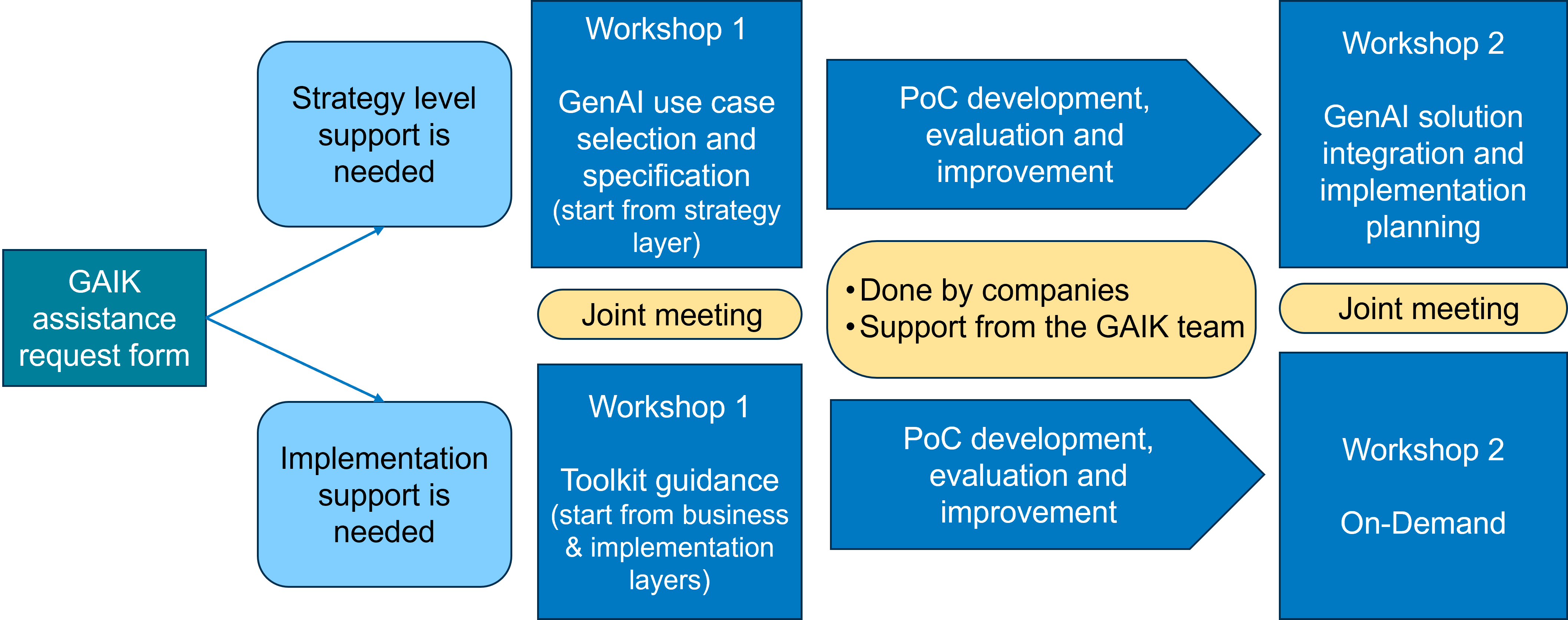
Strategy-Level Support
Best for: Companies exploring GenAI opportunities and needing guidance on use case selection and value assessment.
What we provide:
- Workshop 1: GenAI Use Case Selection & Specification - Starting from the strategy layer, we help you identify, evaluate, and specify the most promising GenAI use cases for your organization
- Joint Meeting - Collaborative session to align on approach and requirements
- Proof-of-Concept Development - Your team develops the PoC with continuous support from the GAIK team for evaluation and improvement
- Workshop 2: Solution Integration & Implementation Planning - Guidance on integrating the GenAI solution into your operations and scaling to production
Implementation-Level Support
Best for: Companies with identified use cases who need technical guidance on toolkit implementation.
What we provide:
- Workshop 1: Toolkit Guidance - Starting from the business and implementation layers, we guide you through selecting and configuring toolkit components for your use case
- Joint Meeting - Technical alignment and hands-on guidance
- Proof-of-Concept Development - Your team implements with GAIK team support for evaluation and improvement
- Workshop 2: On-Demand Support - Flexible follow-up assistance tailored to your specific needs
Get Started with GAIK Support
We want to help you succeed with GenAI!
If your organization has a GenAI-related use case that aligns with the GAIK toolkit capabilities (knowledge capture, access, or synthesis), we invite you to request GAIK assistance.
Our team will work with you to customize the toolkit for your specific requirements and guide you through successful implementation.
Request GAIK Assistance
Scan the QR code to access our assistance request form.
Accessing the Toolkit (Project Resources)
The GAIK toolkit is accessible through multiple channels to serve different user needs:
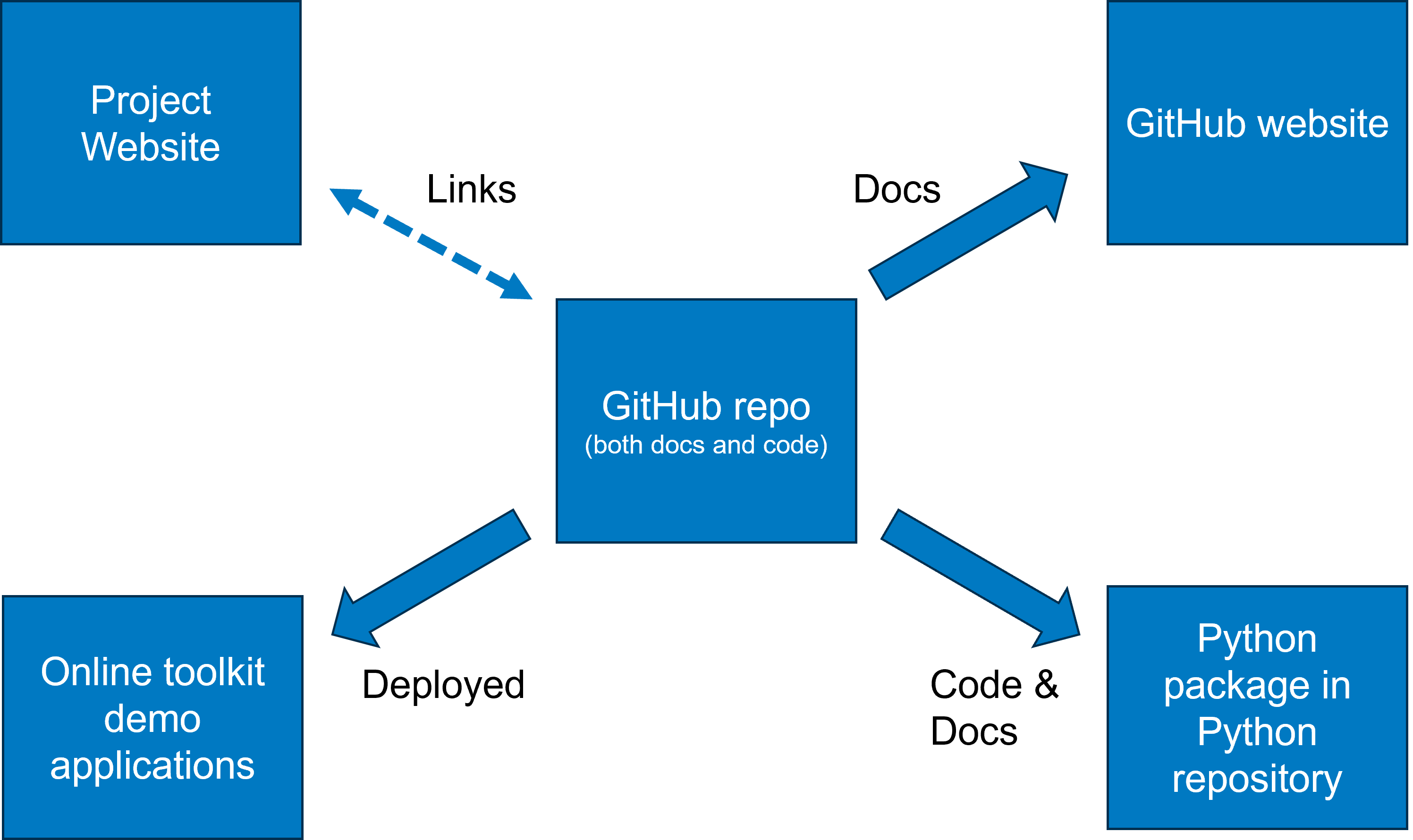
The central GitHub repository serves as the source of truth for both documentation and code. From there, the toolkit is distributed through:
- Project Website - Project's website with announcements, news, and updates (gaik.ai)
- GitHub Website - This documentation site you're viewing now, providing comprehensive guides and references (gaik-project.github.io/gaik-toolkit)
- Online Demo Applications - Live, interactive demonstrations of toolkit capabilities (gaik-demo.2.rahtiapp.fi)
- Python Repository (PyPI) - Installable
gaikpackages available through Python repositories for code-based implementations (pypi.org/project/gaik)
This multi-channel approach ensures that both technical and non-technical users can access the resources most relevant to their needs.
Glossary
The guidance layer provides a glossary that defines key concepts, terminology, and architectural patterns used throughout the GAIK toolkit.
This shared vocabulary ensures that teams—whether technical or non-technical—can communicate clearly about GenAI solutions and understand how different components and layers fit together.
Documentation & Contribution
The guidance layer includes documentation and contribution guidelines that help developers and practitioners contribute to the toolkit, extend its capabilities, and adapt it to new use cases.
By making the toolkit's design principles and extension points explicit, the guidance layer supports a growing ecosystem of reusable GenAI building blocks and best practices.
Key Components
- Implementation Process Guide - Step-by-step guidance for GenAI solution development
- Configuration Wizard - Interactive tool for selecting and configuring building blocks (V1 available, V2 under development)
- Glossary - Shared terminology and concept definitions
- Documentation - Comprehensive guides for software components, modules, and workflows
- Contribution Guidelines - Standards and processes for extending the toolkit
Status: This layer is actively evolving.
Video Search Evaluation
Retrieval-quality assessment for semantic video search, measuring whether the right lecture moment surfaces near the top across Finnish, English, and Swedish queries.
Solution Configuration Wizard
An agentic assistant that guides users from a business problem description to a runnable and validated GenAI proof of concept with complete documentation suite.